
By Gary Lemal
The autumn meeting of Leeds Parks and Green Spaces Forum was hosted by Pudsey’s Greenside Greenway CIO.
Representatives from various parks and other groups around Leeds met on the Carlisle Road bridge, close to The Royal pub.
Members of the Greenside Greenway committee showed the visitors the information board pointed out the Eastern portal of the Greenside railway tunnel tunnel.
Crossing over the road looked down upon the former goods yard of Greenside station, in the distance they could see the far away high rise flats in Seacroft and the cooling towers of a distant power station.
The group were led along New Street Grove and along the foot path forming parts of the Greenway along the old track bed of the Pudsey loop railway line. Until the 1960s the railway had passed under several roads; nowadays these road bridges are blocked however pedestrians can easily cross from one stretch of the Greenway to the next.
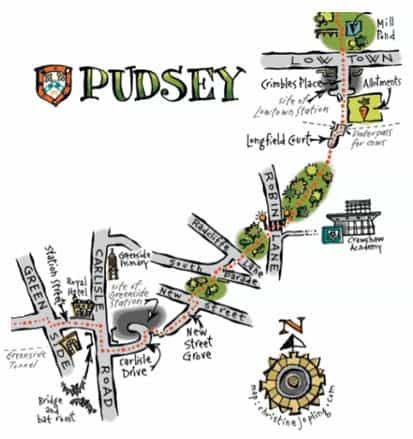
A particularly interesting feature is at the bottom of Longfield Road where an underpass beneath the Railway remains For the people of Pudsey to move their cattle from one side of the track to the other.
When the group arrived at the Crimbles Community Centre they joined others from other parks groups. Warm drinks, biscuits and brownies were still being enjoyed when the meeting commenced.
Linda Kitching, chair of Leeds Parks and Green Spaces Forum, welcomed everybody and thanked Greenside Greenway for hosting the meeting.
Greenside Greenway then spoke very briefly about the objective of creating a low-energy transport corridor through Pudsey.
When asked about the challenges that come with one of the Mass Transit (tram) route options being along the Greenside Greenway; the meeting was told that “Greenside Greenway CIO are aware of the potential disruption to those living on the route, however those decisions are not being made by the Greenway committee, the Greenside Greenway will work with West Yorkshire Combined Authority if this route option is chosen, to ensure that safe low energy travel is properly accommodated”.
An employee of The Royal Horticultural Society (RHS) who has been working on a project at St James’ Hospital, Leeds explained how together they have created a garden to be used by staff as well as patients. The RHS also work with at least 10 different groups who are involved in communities around the East of the city.
The next person to speak was an ecologist working for Leeds City Council, recent legislation has meant that when land is developed there has to be an increase in biodiversity.
This might not be too problematic for a brown field site that is being developed, however on other land it may be more difficult to increase the range of species. She explained the different options available to builders. These ranged from the planting and maintenance regimes to paying for green “land banks” elsewhere. The complicated set of metrics awarding points in different areas were shown to the forum.
The final speaker told the 30 or so people that his 43 years of work for Leeds Parks was coming to end shortly, so he felt able to candidly answer questions he was asked.
“Why do pieces of equipment suddenly disappear from parks?” This was a reference to exercise equipment that had been removed from a trim trail. Such equipment is inspected on a regular basis by parks staff and specialist inspectors. If a piece of equipment is identified as dangerous then it needs to be removed to keep the public safe. The same occurs in graveyards if a headstone is deemed unsafe then it is laid down until such time as it can be properly and secularly reinstated.
The meeting was nearing its end, and parks groups were invited to speak for ‘Just-a-minute’ about their green space,telling of any updates or events that had occurred.
Any parks groups, volunteers looking after a greenspace, in bloom groups or other similar groups in the Leeds area are welcome to join the Leeds Parks & Green Spaces Forum at LeedsParksForum.org.
Sponsored content